
identities in postcolonial setting
by Lamprini Chartofylaka , Maurizio AlìAbstract:
Les identités postcoloniales sont multiples, hybrides et disputées, façonnées par la violence (post)coloniale, l’effacement culturel et l’assimilation administrative. Au sein de ces rapports de pouvoir, les communautés locales ne cessent d’affirmer et de se réapproprier leurs identités. Cette entrée examine le cas des Antilles françaises (Guadeloupe et Martinique) : devenues départements français en 1946, elles restent confrontées à des inégalités qui ne sont plus inscrites dans la loi mais persistent dans la vie quotidienne. L’entrée montre d’abord comment l’école reproduit l’altérité, en faisant des réalités locales une exception à une norme définie ailleurs. Ensuite, à partir de près de quatre-vingts jeux, traditionnels et contemporains, étudiés dans le cadre du projet Outre-Jeu, elle identifie cinq registres, qui vont de la reproduction de l’altérité à l’affirmation d’une identité revendiquée.
Postcolonial identities are inherently multiple, hybrid, and contested, shaped by centuries of (post)colonial violence, cultural erasure, and administrative assimilation. Within these power dynamics, local communities continuously assert, reclaim, and re-signify their identities on their own terms. This entry examines a particular postcolonial context, the French Antilles (Guadeloupe and Martinique), showing how Otherness is reproduced in school curricula and how traditional and contemporary games range from reproducing it to transforming it into collective cultural affirmation.
Etymology:
Identity (French identité) comes from the Latin identitas (accusative identitatem), an abstract noun formed from idem, “the same” (Littré, 1863–1872). The Trésor de la langue française adds that this Late Latin word was coined to translate the Greek ταὐτότης (tautótēs, “sameness”) (TLFi). The word appears in French in the fourteenth century, first in a logical sense: the quality that makes two things or two persons one and the same. Voltaire even noted that the term could be rendered in French as mêmeté, “sameness”. In the eighteenth century, the word came to mean a person’s awareness of remaining the same self over time, and at the turn of the nineteenth century it took on its legal sense: the fact that an individual is indeed who they claim to be, as in identity papers. The word thus carries a tension at the heart of this entry: identity designates both what remains the same and what distinguishes one person or group from others.
Cultural specificity:
The notion of identity was developed by psychologists as a synonym of personality.
Sigmund Freud and the first generation of psychoanalysts were interested in understanding the complexity of ego identity, while early developmental psychologists preferred to focus on the process of identity formation. During the first half of the 20th century, the notion was adopted by social anthropologists and applied to the cultural traits of other human groups.
Contemporary anthropology rejects the essentialist belief that every member of a group possesses identical cultural characteristics and that these attributes remain unchanged over time. Mondher Kilani urges caution in using the term identity: in his view, it is a concept that can very easily become a stereotype, a source of prejudice or extremist positions (Kilani, 1997).
Ugo Fabietti argues that belonging to a particular human group (religious, political, or ethnic) is primarily symbolic. Fabietti considers that: “It is not enough to have a certain skin colour to belong to an ethnic group; nor is it enough to speak a certain language or share certain values or behaviours. Ethnic identity and ethnicity [...] are definitions of the self and/or the other that are always rooted in power relations between groups united around specific interests” (Fabietti, 1995, p.14). In other words, anthropological reasoning invites us to relativize identities without essentializing differences.
National identity is a very peculiar typology of cultural identity: it is hegemonic and produced by nationalist rhetoric, serving the interests of certain political forces with the aim of standardizing individual identities and creating citizens of the Nation, while stigmatizing cultural differences that could not be integrated into national society, such as subaltern cultures.
| 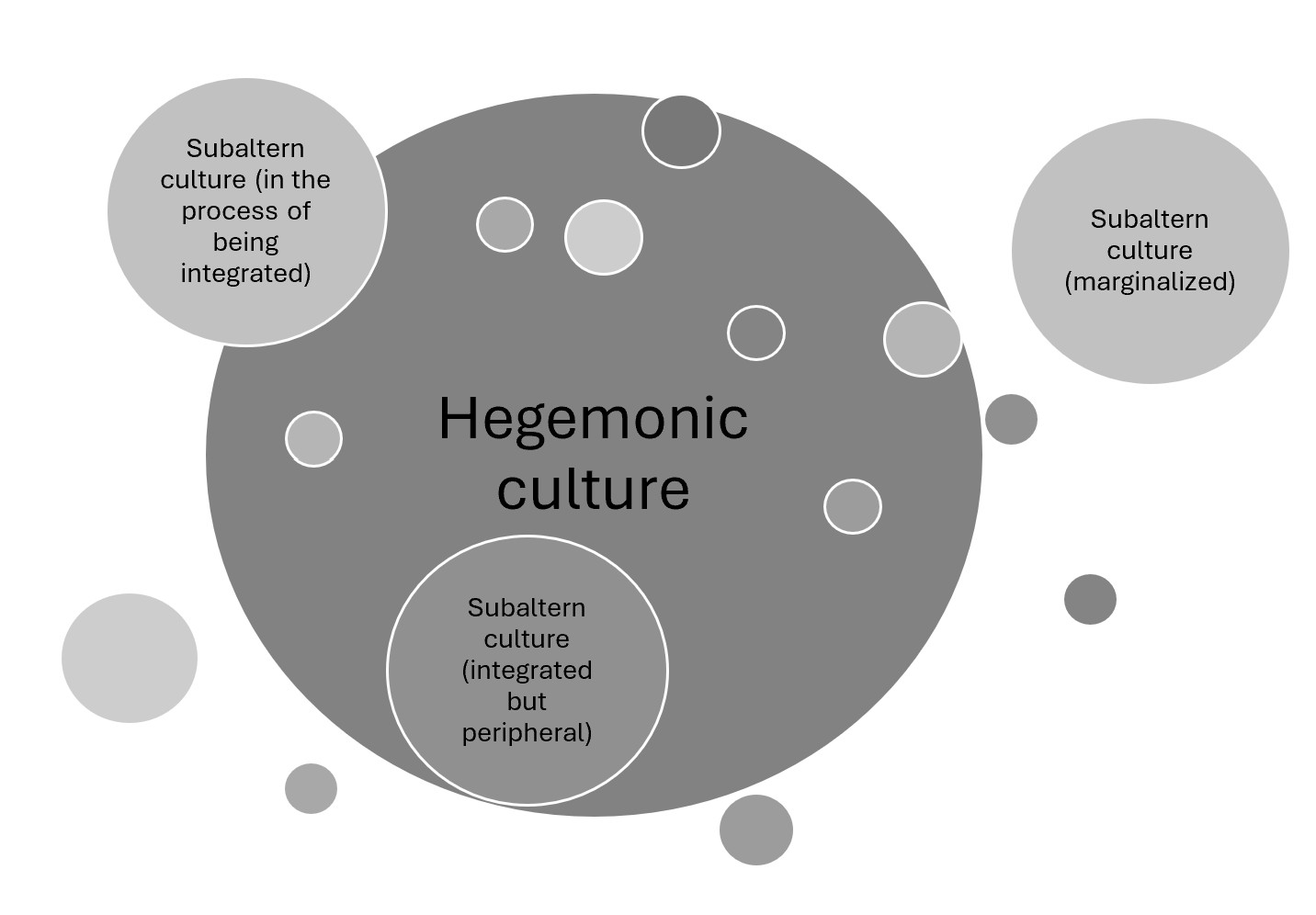 Adapted from Alì (2023a, p. 67) |
Nationalist discourse, especially in Nation-States and colonial empires, aimed to provide an ideological justification for the idea that one hegemonic culture could be superior to others. These other cultures were not necessarily those of minorities but simply those that did not meet the criteria chosen by the political and economic elites and that hindered the plans of governments.
History is full of examples that show us how this discourse has been translated into policies aimed at eliminating otherness, justified by the need to preserve national purity and unity: from religious wars to ethnic conflicts, from the Holocaust to pogroms and genocides. However, it should not be forgotten that, in most cases, these policies concealed motivations that were less ideological than geopolitical, linked to access to certain resources and their distribution (Wolf, 1982).
 depending on the context. Toulouse, 11 February 2012. Photo: Pierre-Selim Huard, Wikimedia Commons, CC BY-SA | This hegemonic logic persists even today in postcolonial contexts and explains the motives behind the foreign policy of the great powers and the so-called “Western democracies”: the maintenance of geopolitical control over strategic territories and resources (Alì, 2010; Gay, 2026). Bruno Saura's concept of cumulative identity describes how, in certain contexts of planned acculturation, ethnic and national identities can coexist and juxtapose one another, based on a “relative weakening of identity divisions” (Saura, 1998, p.7): members of a group use one identity or the other according to the demands imposed by the context, in order to benefit from the advantages that each identity can grant them. |
Beyond this strategic coexistence, Georges Balandier (1955, 1971) demonstrated that colonisation failed in imposing all its cultural principles, and that colonised populations made choices to determine which borrowings to integrate: an additive outcome, where the borrowed feature coexists with the pre-existing one, or a substitutive one, where it replaces it. Furthermore, borrowings can lead to changes in the symbolic systems of the groups in question, where “old meanings are attributed to new elements” or “new values change the cultural meaning of old forms” (Herskovits, 1948, p. 248). This then gives rise to reinterpretation: the principle underlying syncretic and hybrid identities. As Maurizio Alì observes, the debate on the educational question in pluricultural contexts positions the educational act itself as a lever of identity claim-making and symbolic resistance, within a global context marked by constrained trajectories “between pure and simple assimilation, cultural adaptation, or disappearance” (Alì, 2023b, p. 14).
Identity in postcolonial contexts: the French Antilles
In this entry, the French Antilles refers to Guadeloupe and Martinique, two French overseas departments in the Caribbean.
Throughout the second half of the twentieth century, the decolonization process fuelled a major debate in cultural circles about the authenticity of the mixed cultures that had emerged from colonial policy. In the former colonies of the Caribbean and West Africa, intellectuals associated with the Négritude movement (Léon Gontran Damas, Aimé Césaire and Léopold Sédar Senghor, to name a few paradigmatic examples) contributed to the conceptualization of Black identity in ethnic terms, as a community sharing the same African roots and the same marginalization as a discriminated group.
More recently, a critical review of their work has contributed to the emergence of another approach, créolité [creolity], which is considered less essentialist and more suited to the multicultural reality of the Caribbean. In this perspective, rather than thinking of negritude as an ethnicity, the emphasis is placed on Creole cultural identity, based on a language and way of life transmitted and reshaped over generations (Bernabé, Chamoiseau & Confiant, 1989; Bernabé et al., 2000). This identity is rooted in a painful local history held in memory (slavery and the colonial situation), but also in different cultural backgrounds that are sometimes in conflict with each other (African origins, the plantation economy, diasporas and immigrant communities).
From the 1970s onwards, postcolonial studies, prominent in former British colonies such as India (Spivak, 1987; Bhabha, 2012), and decolonial studies, rooted in Latin American thought (Quijano, 2007; Mignolo, 2013), exposed the geopolitics of power and hegemonic knowledge that outlived formal decolonization (Bhambra, 2014). They echoed Black Studies, which since the 1960s has analysed the experience of communities descended from slavery, the slave trade, and the African diaspora (Hare, 1965; Mintz and Price, 1976; De Friedemann and Arocha, 1986; Nguirane, 2020). These approaches remain contested, notably by conservative and neoconservative critics who denounce them as sectarian and dogmatic. | 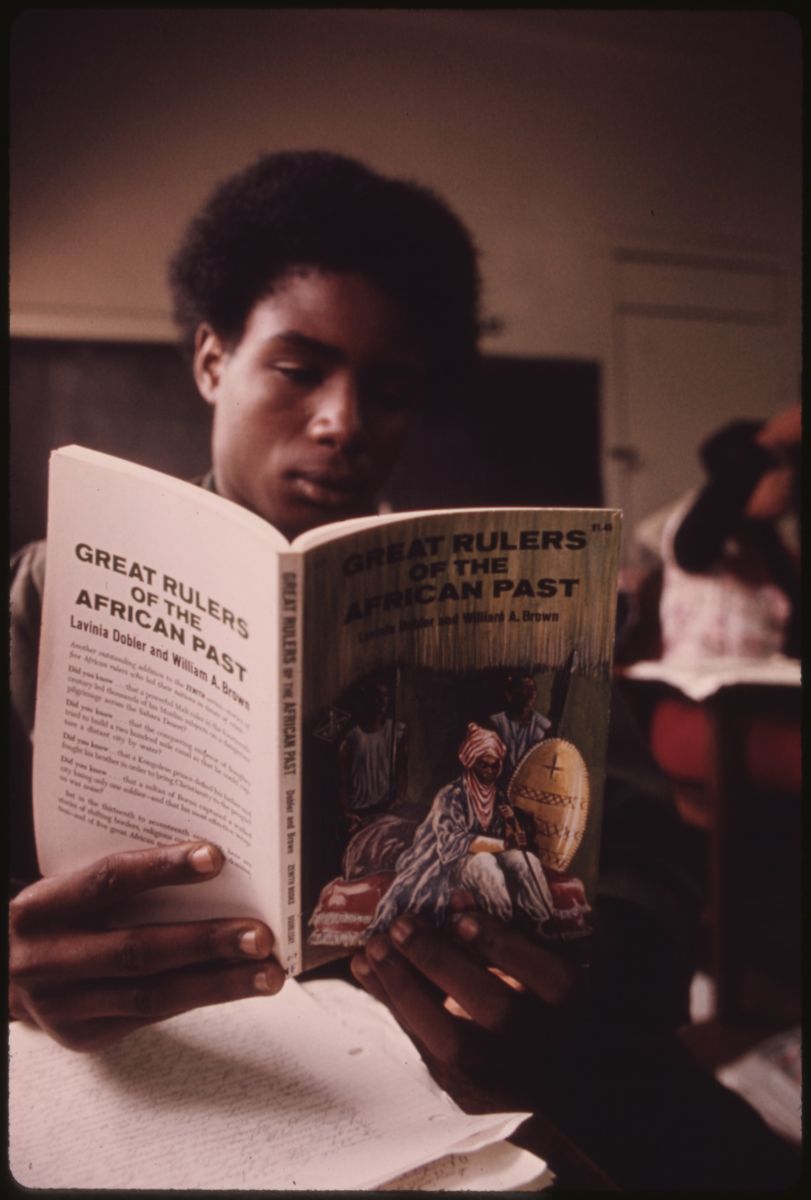 in Chicago, 1973. Photo: John H. White, U.S. National Archives, Wikimedia Commons, public domain. |
Since the 1980s, cultural, gender-based and religious identity claims have become central to public debate (Alì et al., 2014; Alì, 2015). Some states have responded with forms of political recognition: either valuing differences through corrective measures, as with American affirmative action (Wang, 1983; Kymlicka, 1998; Stojanović, 2013), or, as in France since the end of the Second World War, adopting a principle of “indifference to differences” whereby the State disregards “race, religion or belief” in administering rights and obligations (Todorov, 2008). Both models have shown their limits: the former can create new inequalities by favouring one minority over another, while the latter often turns into indifference to discrimination (Macé, 2007).
This administrative dimension is not incidental to the Antillean case; it is one of the clearest illustrations of how Otherness can persist even after its formal, legal grounds have been removed.
The 1946 Loi de Départementalisation [Departmentalisation Act] made Guadeloupe and Martinique, along with French Guiana and Réunion, Départements d'Outre-mer (DOM) [Overseas Departments] (Loi n° 46-451 du 19 mars 1946). It was framed as an act of equality: rather than remaining colonies, these territories would become constitutionally and administratively French, subject to the same laws and curriculum as any mainland department. In reality, the inequality between mainland France and these distant territories did not disappear: it simply became less visible, no longer written into law but still present in everyday life.
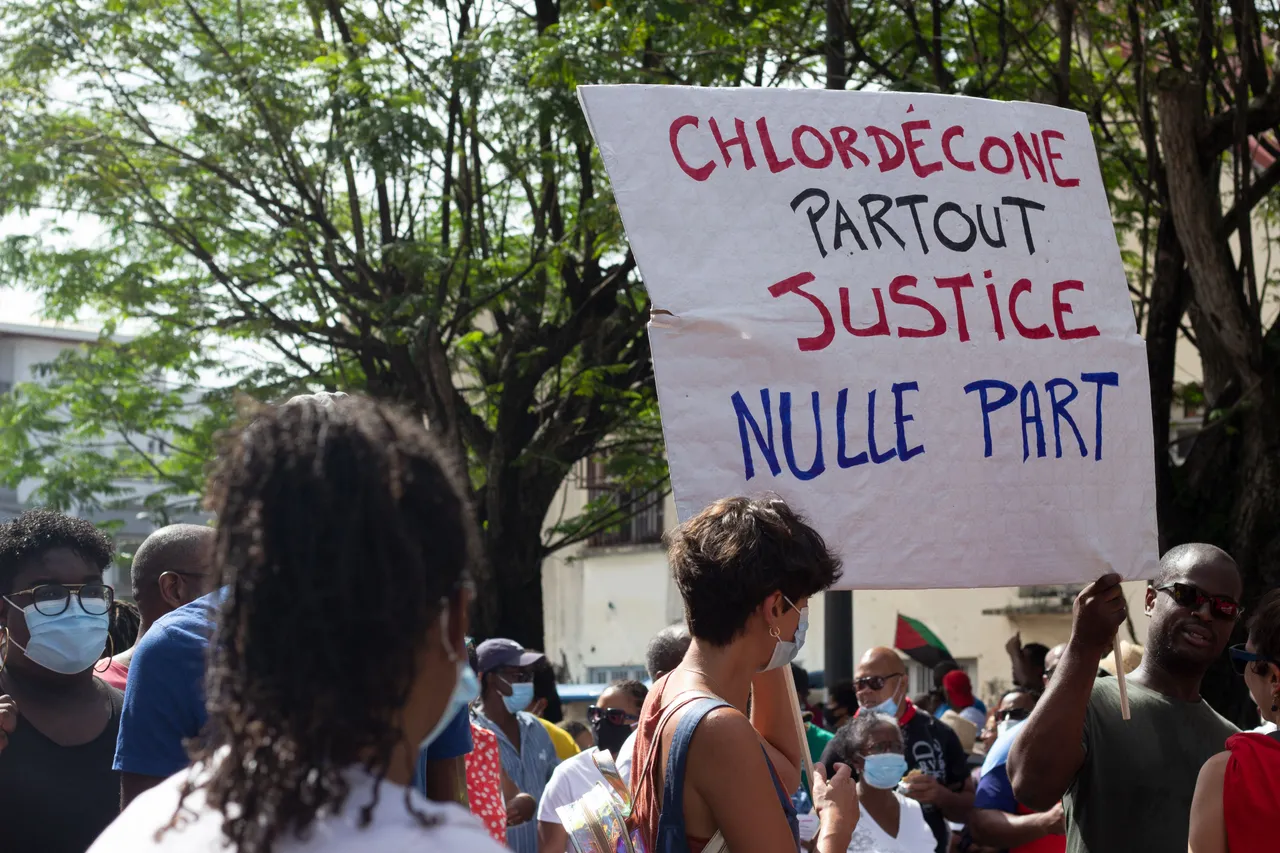 Photo: Fanny Fontan / Hans Lucas / AFP, reproduced with the photographer’s permission. | Today, for instance, Guadeloupe still faces recurring water cuts. The chlordecone scandal, by contrast, dates back several decades, but its effects persist: this pesticide, flagged by the World Health Organization’s cancer agency as early as 1979, was used massively in banana plantations across the Antilles from the 1970s onwards. It was withdrawn from sale in the United States in 1976 and banned in France in 1990, yet its use continued in Guadeloupe and Martinique under ministerial exemptions until 1993. It caused lasting contamination of soils, rivers and coastal waters, and it still affects the health of local residents today (Fieschi, 2026). |
For Malcom Ferdinand (2019), this contamination extends the logic of the plantation, a “colonial inhabitation” of the Earth in which land and people are exploited to produce goods for export, regardless of the consequences for those who live there. In court, no one has been held criminally responsible: the case ended in a dismissal [non-lieu], confirmed on appeal in June 2026. That same month, however, a law recognised the State’s responsibility, opening the way to compensation without making the victims' compensation mandatory (Fieschi, 2026). Both cases, past and present, illustrate the same structural neglect: legal equality has not guaranteed equality in the material conditions of existence.
Problematization:
This entry is grounded in the idea that identity is relational: it is built in relation to others, and, as Fabietti (1995) reminds us, the definition of the Other is always rooted in power relations between groups. But, as Édouard Glissant wrote from the Caribbean, identity lies “no longer entirely in the root, but also in Relation” (Glissant, 1990): not in a single origin, but in the connections woven between peoples and cultures. The French Antilles offer a telling case. Since 1946, Guadeloupe and Martinique have been legally equal to any other French department, yet decisions affecting them are still largely made elsewhere, and inequalities persist in everyday life. At the same time, Antillean societies have never ceased to affirm, reinvent and claim their own identity. The question is therefore twofold: how does Otherness persist once it is no longer written into law, and how do those to whom it is assigned challenge and re-signify it?
School and games offer two answers. By applying the same programmes everywhere, the school tends to present the Antillean environment as an exception to a norm defined elsewhere. Games, as cultural objects, can either reproduce this outside gaze or reverse it, depending on who creates them and what role they give the player (see Subversion). Underlying both, créolité (creolity) reminds us that Antillean identity is neither imposed nor fixed, but built from elements received, transmitted and reinvented. If identity, like a game, is shaped by its rules, the question remains: who gets to write them?
Otherness reproduced: school curricula and textbooks
The school is where the universalism of the Republic becomes everyday practice, and it offers a particularly telling illustration of how Otherness is reproduced. It applies the principle of “indifference to differences” mentioned above, which is the legal expression of the Republican motto “Liberté, Égalité, Fraternité” [Liberty, Equality, Fraternity]. A single narrative is meant to apply equally to all students, whatever their origin: the Republic officially recognises citizens, not ethnic or cultural groups. Students in mainland France and in the overseas territories, such as the French Antilles, therefore follow the same national curricula and use the same textbooks. Two examples, drawn from history and science teaching, show how this single framework can produce Otherness.
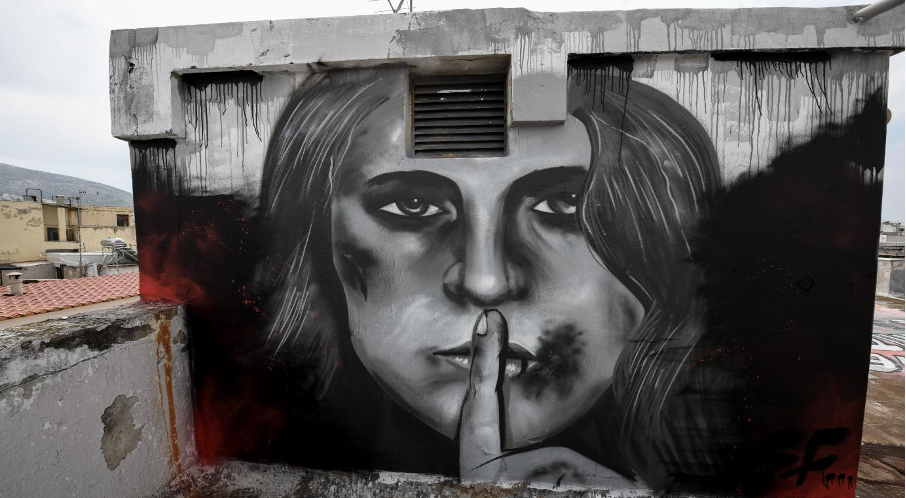 Wikimedia Commons, public domain. | In history lessons, for a long time, students learned a narrative of the Nation centred on the great figures and events of mainland France (the part of the country located in Europe), often presented in a glorifying way. The expression "Nos ancêtres les Gaulois" ["Our ancestors, the Gauls”], which refers to the peoples who lived in present-day France before the Roman conquest, became the symbol of this discourse in textbooks of the late 19th and early 20th centuries (Durpaire, 2003; Ha, 2003).
|
Although the expression has long disappeared from today’s textbooks, it remains one of the most striking emblems of the assimilation policy of the French colonial empire: in the overseas territories, children descended from enslaved Africans, Amerindians or indentured Indian workers were taught to claim as ancestors a people with whom they shared neither history nor origins, while their own histories were silenced or treated as secondary (Ha, 2003). As Anthony Faramelli (2016) notes, Frantz Fanon and Édouard Glissant, two of the most influential Martinican thinkers, both recited it as schoolchildren, learning to claim counterfeit white ancestors that banished their African ancestry into a kind of “non-history”. Outside school, the expression still circulates today, often ironically, as shorthand for a Eurocentric vision of French history, and it continues to resurface in political debate.
This assigned identity is not limited to history; it extends to the very way knowledge is organised. In the Antilles, the gap between this national frame and local realities becomes a form of Otherness in its own right: not exclusion by decree, but structural invisibility. A study on science teaching in Guadeloupe (Merlo-Leurette & Forissier, 2009) gives a telling example. A student who opens a French science textbook (in SVT, the school subject of life and earth sciences) encounters a world that is not quite their own: plants are said to draw their nutrients from the soil, a model that leaves no room for the epiphytic plants (plants that grow on other plants rather than in the ground) found on trees all over Guadeloupe. The student’s own environment is thus treated as an exception to a norm defined elsewhere, rather than as a valid starting point for knowledge. | 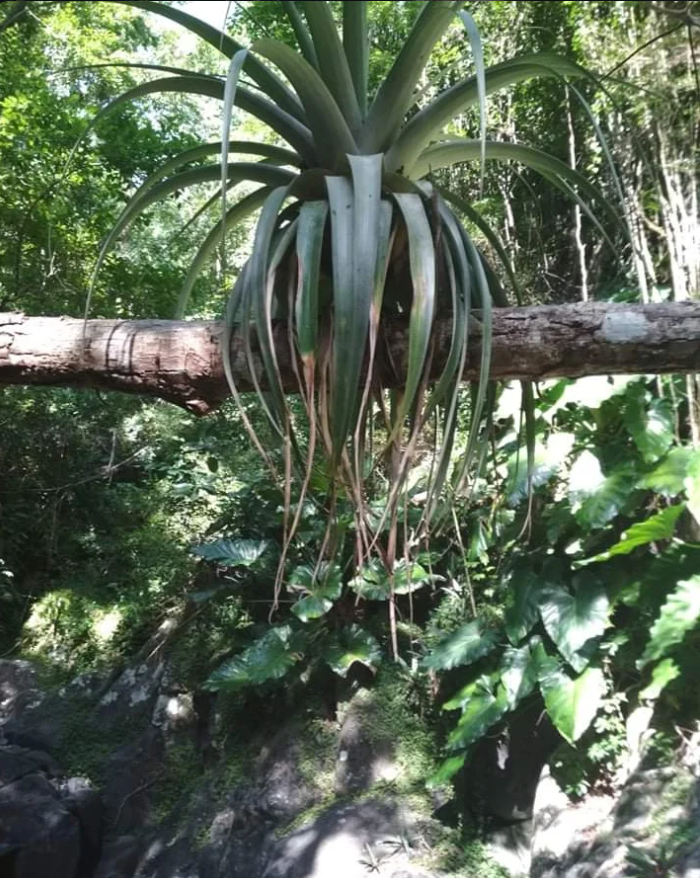 Photo: L. Chartofylaka, personal archive. |
Attempts to make room for local realities have led to only limited changes, given the rigid structure of the curricula (Ailincai et al., 2012, 2018, 2022). These adaptations are decided centrally and leave the national curriculum itself untouched. As Thomas Forissier argues, real contextualisation means more than adding local examples to a fixed national norm: it is a collective process in which teachers, students and all those involved transform what counts as knowledge (Forissier, 2019).
Teachers and researchers in the French Antilles already work in this direction. For more than a decade, the CRREF (Contextes, Recherches et Ressources en Éducation et Formation) [Context, Research, and Resources in Education and Formation], a research unit in education at the Université des Antilles, has made didactic contextualisation one of its main research areas, from theoretical work (Anciaux, Forissier & Prudent, 2013; Delcroix, Forissier & Anciaux, 2013) to studies across many disciplines, for example language teaching (Anciaux, 2019), business studies (Odacre, 2018), history, geothermy and sustainability education (Chartofylaka, 2022), and mathematics (Garçon et al., 2026). The full body of this work is available in the CRREF collection on HAL. Where the school struggles to do this, other cultural objects, such as games, can take on part of this task.
Subversion:
Otherness challenged and re-signified: games
If schools reproduce Otherness from above, games are a space where it can be reproduced but also challenged. Games are cultural objects and never neutral: their rules, themes and materials assign players a role (Caillois, 1958; Brougère, 1995), and they can be designed as tools for learning, conveying knowledge and values to those who play them (Chartofylaka & Delcroix, 2026). Espen Aarseth’s (2007) notion of the implied player names this mechanism: a game constructs a position that the player must occupy in order to play.
Within the framework of the “Outre-Jeu research project”, a corpus of nearly eighty games connected in some way to Guadeloupe or Martinique was built, including games produced elsewhere that use the Antilles as a setting or simply borrow their name. Each game was read through three questions: who the player is asked to be, what the islands become as a setting, and where their inhabitants stand, whether absent, stereotyped, turned into a resource or placed at the centre. The answers sketch five registers through which games relate to Antillean identity, ranging from Otherness reproduced to identity claimed. | 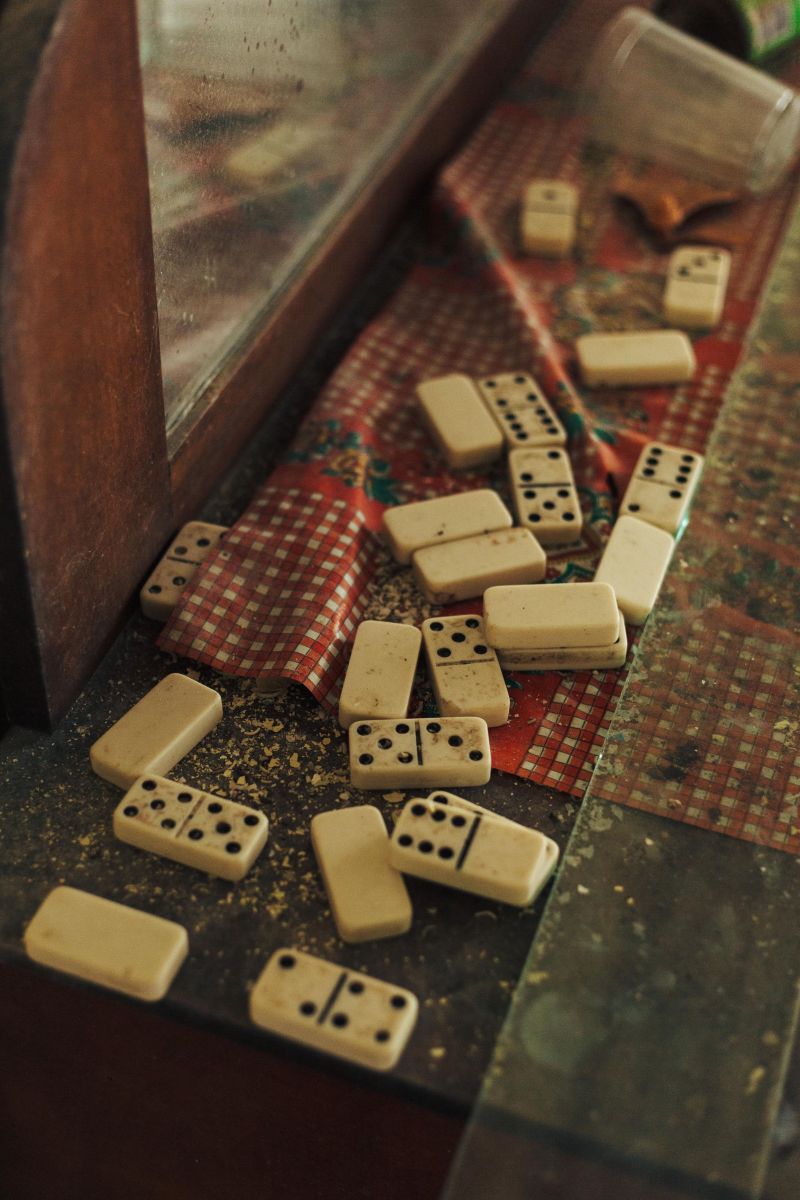 from generation to generation in the Antilles. Photo: Cédrick-Isham Calvados, reproduced with the photographer’s permission. |
The first register makes the islands a resource, replaying the economics of colonisation. In Puerto Rico (2002), players run plantations and score by shipping goods to Europe, while labour arrives by “colonist ship” as anonymous tokens, a euphemism for the enslaved people on whom such economies relied (Borit et al., 2018). In Comptoir des Antilles [Trading Post of the Antilles] (2012), set in a port town “somewhere in the Antilles”, players assign porters to load ships bound for Europe with rum or madras fabrics. In both games, the player is the coloniser who organises production and export, and the inhabitants appear only as a workforce to be allocated, a means but never subjects. Otherness is reproduced through the mechanics themselves, since winning means optimising what the islands can yield.
The second register makes the islands a décor. The player is a pirate or adventurer, and the inhabitants are simply absent. In Caribbean (2004), players bribe pirate crews with rum to bring treasure to their ports, in a Caribbean without reference to any island or culture. Martinique (2009), a two-player treasure hunt, goes further: in his review for the “Escale à jeux ludothèque" website, François Haffner (2012) notes that the name may owe more to the popularity of pirate themes than to the island itself, and that the board bears little resemblance to Martinique. The Antilles function as a label rather than a place. Here Otherness is reproduced not through exploitation but through erasure: the islands are reduced to sun, sea and treasure, emptied of history and people.
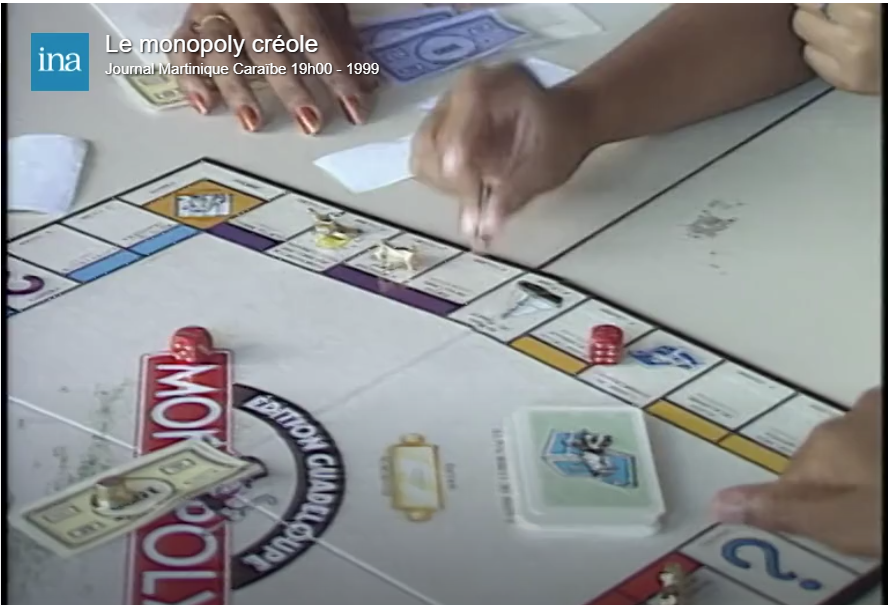 Source: Institut national de l'audiovisuel archive (ina.fr) | The third register is the most widespread: existing games are adapted to Antillean culture. The player becomes someone who recognises and names the island, and its inhabitants finally appear, through their fauna, flora, food, music and personalities. Some adaptations localise licensed commercial brands: Monopoly (1999) and Trivial Pursuit (2000) have been released in Antillean editions, and in Dobble Martinique (2022), the publisher set aside seaside imagery in favour of what is specifically Martinican and added a Creole lexicon to the 57 symbols. |
Other examples re-illustrate family and classroom classics, usually through small local publishers with an educational aim. Premié rivé [meaning “first arrived” in Creole] (2022) applies the rules of UNO to Martinican flowers, while Pouchine [familiar name for “kitty” in Creole] (2023) replaces the cat of the Mistigri (an old maid–type card game) with a local kitten. In all these cases, Antillean culture is valued rather than erased, but it is added to a game whose rules and structure remain those of the original: the local changes the images and the vocabulary, not the way the game is played. Identity thus tends to appear as a catalogue of emblems to recognise rather than as something to play. Some adaptations go further: Fon Lèspri Koko [meaning “Deep Coconut Spirit”, but playing on the Creole slang for “Deep inside the Mind”] (2021) uses the mechanics of Werewolf (Loup-Garou) but draws its story from Creole tales and legends, so that the local reshapes the story, not only the images.
The fourth register concerns games transmitted across generations and reinterpreted, which remain very much alive today. Dominoes have been part of Antillean life for centuries, as archaeological traces show. A domino carved from a lambi shell [queen conch], found in an eighteenth-century layer at Fort Saint-Louis in Fort-de-France (Martinique), suggests that dominoes were already being made locally at the time (Tomadini & Coulaud, 2022). Dominoes also joined an older playing tradition. Stoffle and Baro (2016) argue that in Caribbean plantation societies, men of African descent played oware (also known as awalé), a West African mancala game that Europeans likely tolerated because it appeared harmless. Around the board, they suggest, enslaved men could gather, bond and organise, creating a creole social space beyond the masters’ control.
Today, dominoes remain a fundamental marker of Antillean social life, with their own vocabulary and expressions, and their regional variants, usually played with three players in Martinique and four in Guadeloupe. This heritage keeps reinventing itself: toddlers learn it with Domino Zannimo (2024), a set of animal dominoes named in Creole, and the digital era has embraced it through Caribbean-inspired mobile applications such as Domino Clash (2025). At the same time, associations such as Gwajéka work to transmit other traditional games, such as Timarèl, Kristal and Awalé, thus keeping this older heritage alive. Awalé is also a classic object of study in fields such as ethnomathematics, which examines mathematical ideas and practices within their cultural contexts, and psychodidactics; it has been used in schools in mainland France and the overseas territories to teach counting and early arithmetic, and to train teachers (Numa-Bocage, 2023). In these spaces, identity is not merely represented; it is practised. What was inherited stays alive because it is played, taught and constantly reshaped into new forms.
 |
|
Other games turn Creole into the very fabric of gameplay. This is seen in Jédimo [Word game] (2021), where teams guess Creole words, and TiKozé [Small chat] (2021), named after the kozé, the conversation through which cultural heritage is passed down. Still others tackle pressing local issues. Chlordicus (2022) addresses chlordecone pollution: its question cards were written by Martinican high school students after interviewing planters, fishers and other professionals. Eau secours [Water SOS; a play on the French au secours, “help!”, replacing au with its homophone eau, “water”] (2023) turns the water crisis in Guadeloupe into a puzzle video game, and Écoc’île [whose title blends éco- and île (“island”) and visually echoes ecocide] (2025), developed by INRAE Antilles-Guyane, challenges players to cooperatively manage an archipelago to prevent ecological collapse, subverting traditional resource-management mechanics towards opposite goals. In these games, the Antilles serve neither as a resource, a backdrop nor a showcase: their inhabitants are the true subjects of the game, and identity is reclaimed rather than assigned.
Acknowledgements
Part of this entry builds on the Outre-Jeu project.
Lamprini Chartofylaka thanks the GIS Jeu et Sociétés for the personal research grant awarded to her, and ATLAS International for its support and partnership in this project.
The authors warmly thank Fanny Fontan and Cédrick-Isham Calvados for kindly allowing the reproduction of their photographs.
Discussion:
The Antillean case goes beyond the Caribbean: everywhere, schools and games tell us who “we” are and who “the Others” are. These questions invite you to look at your own experience:
- Do your school textbooks tell the history of everyone in your country, or mainly of one group? Are some people missing?
- If you grew up in mainland France, what did you learn at school about the overseas territories?
- When you play a game, do you think about the role it asks you to take on, and who that role leaves out?
- Is there a game you played as a child that you now see differently?
- If identity, like a game, is shaped by its rules, who writes the rules where you live?
References/Further Readings:
- Aarseth, E. (2007). I fought the law: Transgressive play and the implied player. In Proceedings of the 2007 DiGRA International Conference: Situated Play (pp. 130–133). Digital Games Research Association.
- Alì, M. (2023a). Cultures, savoirs et identités : questions vives en anthropologie de l'éducation. Presses universitaires des Antilles. https://doi.org/10.3917/pua.ali.2023.02
- Bernabé, J., Chamoiseau, P., & Confiant, R. (1989). Éloge de la créolité. Gallimard.
- Bhambra, G. K. (2014). Postcolonial and decolonial dialogues. Postcolonial Studies, 17(2), 115–121. https://doi.org/10.1080/13688790.2014.966414
- Borit, C., Borit, M., & Olsen, P. (2018). Representations of colonialism in three popular, modern board games: Puerto Rico, Struggle of Empires, and Archipelago. Open Library of Humanities, 4(1). https://doi.org/10.16995/olh.211
- Mintz, S. W., & Price, R. (1976). An anthropological approach to the Afro-American past: A Caribbean perspective. Institute for the Study of Human Issues.
Ludography
- Caribbean (2004). M. Antonow & J.-P. Schliemann. [Board game]
- Chlordicus (2022). Students of Lycée Acajou 1 (Le Lamentin), along with their teachers and J. Oublié; game design La Kazajeux. [Board game]
- Comptoir des Antilles (2012). O. Pauwels. [Board game]
- Dobble Martinique (2022). La Kazajeux; illustrations L. Vallerie. [Card game]
- Domino Clash (2025). V. Villet & H. Jumeau. [Mobile app]
- Domino Zannimo (2024). G. Ouana. Yékrik. [Domino game]
- Eau secours (2023). S. Curier. [Video game]
- Écoc’île (2025). INRAE Antilles-Guyane (GAMAE). Azao Games. [Board game]
- Fon Lèspri Koko (2021). D. Lurel. Carré Tropical. [Board game]
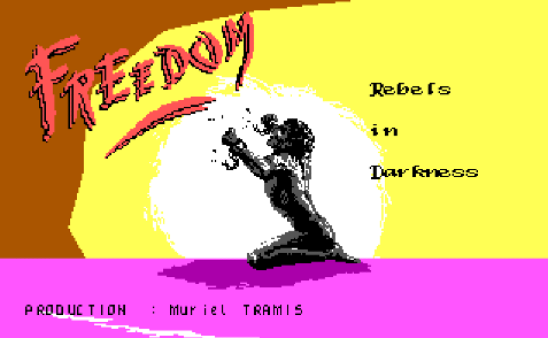
- Freedom : Les guerriers de l’ombre (1988). M. Tramis & P. Chamoiseau. Coktel Vision. [Video game]
- Jédimo (2021). Association Karukrea. [Card game]
- Kytangomingo-Ema (2013). Association Karisko. [Board game]
- Martinique (2009). E. Ornella. [Board game]
- Monopoly: Édition Guadeloupe (1999). [Board game]
- Pouchine (2023). G. Ouana. Yékrik. [Card game]
- Premié rivé (2022). S. Andrivon-Milton. SAM Éditions. [Card game]
- Puerto Rico (2002). A. Seyfarth. alea. [Board game]
- TiKozé (2021). K. Nabajoth. [Card game]
- Trivial Pursuit: Édition Antilles (2000). Hasbro. [Board game]
Extended Bibliography
- Aarseth, E. (2007). I fought the law: Transgressive play and the implied player. In Proceedings of the 2007 DiGRA International Conference: Situated Play (pp. 130–133). Digital Games Research Association.
- Ailincai, R., Alì, M., & Alby, S. (2018). Epistemic activities, schooling and parenting styles: A case study in French Guiana rural contexts. Contextes et didactiques, 12. https://doi.org/10.4000/ced.1119
- Ailincai, R., Alì, M., Cadousteau, M., & Guy, E. (2022). La continuité pédagogique dans les mers du Sud: parentalité et enseignement à distance en Polynésie française pendant la pandémie de COVID-19. In P.-O. Weiss & M. Alì (Eds.), L'éducation aux marges en temps de pandémie : précarité, inégalité et fractures numériques (pp. 41–78). Presses universitaires des Antilles. https://doi.org/10.3917/pua.weiss.2022.01.0041
- Ailincai, R., Jund, S., & Alì, M. (2012). Comparaison des écosystèmes éducatifs chez deux groupes d'Amérindiens : les Wayãpi et les Wayana. Revue française d'éducation comparée, 8, 55–90.
- Alì, M. (2010). Conflicto, modernidad y desarrollo en un territorio de frontera: el caso de Urabá. In M. Serje (Ed.), Desarrollo y conflicto: territorios, recursos y paisajes en la historia oculta de proyectos y políticas (pp. 40–78). Ediciones Uniandes.
- Alì, M. (2015). How to disappear completely: Community dynamics and deindividuation in neo-shamanic urban practices. Shaman: Journal of the International Society for Academic Research on Shamanism, 23(1/2), 17–52.
- Alì, M. (2016). L’idéologie éducative Wayana-Apalaï : l’identité culturelle autochtone à l’épreuve de l’écosystème. Nuevo Mundo Mundos Nuevos [En ligne], mis en ligne le 10 octobre 2016. URL : http://nuevomundo.revues.org/69552.
- Alì, M. (2019). Qu’est-ce que l’identité ? Séminaire Premier Campus de SciencePo Paris. Université des Antilles, Schoelcher, Martinique, 1 juillet.
- Alì, M. (2021). L’idéologie éducative Enata : processus postcolonial et réinvention d’une identité culturelle autochtone aux îles Marquises, en Polynésie française. Contextes et Didactiques, 18. https://doi.org/10.4000/ced.3167
- Alì, M. (2023a). Cultures, savoirs et identités : questions vives en anthropologie de l'éducation. Presses universitaires des Antilles. https://doi.org/10.3917/pua.ali.2023.02
- Alì, M. (2023b). Autochtonie et question éducative dans les Outre-mer : une enquête comparative en Guyane et en Polynésie française. Presses universitaires des Antilles. https://doi.org/10.3917/pua.ali.2023.01
- Alì, M., Basabe Murillo, D. F., & Magak, M. A. (2014). Resiliencia, inculturación y sincretismo religioso: notas etnográficas acerca de la pastoral afrocolombiana. DADA: Rivista di Antropologia post-globale, 4(2), 53–72.
- Anciaux, F. (2019). Vers une didactique du français langue en contact en Guadeloupe : problématiques et actions de recherche. Le Français dans le monde. Recherches et applications, 66, 53–68.
- Anciaux, F., Forissier, T., & Prudent, L. F. (Eds.). (2013). Contextualisations didactiques : approches théoriques. L’Harmattan.
- ATILF. (n.d.). Identité. In Trésor de la langue française informatisé (TLFi). ATILF – CNRS & Université de Lorraine. https://www.cnrtl.fr/definition/identité
- Balandier, G. (1955). Sociologie actuelle de l’Afrique noire. Presses Universitaires de France.
- Balandier, G. (1971). Sens et puissance: les dynamiques sociales. Presses Universitaires de France.
- Bernabé, J., Chamoiseau, P., & Confiant, R. (1989). Éloge de la créolité. Gallimard.
- Bernabé, J., Bonniol, J.-L., Confiant, R., & L'Étang, G. (Eds.). (2000). Au visiteur lumineux: des îles créoles aux sociétés plurielles. Mélanges offerts à Jean Benoist. Ibis Rouge.
- Bhabha, H. K. (2012). The location of culture. Routledge.
- Bhambra, G. K. (2014). Postcolonial and decolonial dialogues. Postcolonial Studies, 17(2), 115–121. https://doi.org/10.1080/13688790.2014.966414
- Borit, C., Borit, M., & Olsen, P. (2018). Representations of colonialism in three popular, modern board games: Puerto Rico, Struggle of Empires, and Archipelago. Open Library of Humanities, 4(1). https://doi.org/10.16995/olh.211
- Brougère, G. (1995). Jeu et éducation. L'Harmattan.
- Caillois, R. (1958). Les jeux et les hommes: le masque et le vertige. Gallimard.
- Chartofylaka, L. (2022). Apprentissage basé sur les effets de contextes [Doctoral dissertation, Université des Antilles]. https://hal.science/tel-03977433
- Chartofylaka, L., & Delcroix, A. (2026). Projet TiNum : jouer pour sécuriser ses mots de passe, apprendre pour se protéger. In B. Franco, E. Belmas, & B. Noyet (Eds.), Rencontres autour du jeu. Volume II : Actes des journées d’étude et colloques du GIS Jeu et Sociétés (2021–2023) (pp. 249–268). Éditions Orbis Tertius.
- De Friedemann, N. S., & Arocha, J. (1986). De sol a sol: génesis, transformación y presencia de los negros en Colombia. Planeta.
- Delcroix, A., Forissier, T., & Anciaux, F. (2013). Vers un cadre d’analyse opérationnel des phénomènes de contextualisation didactique. In F. Anciaux, T. Forissier, & L. F. Prudent (Eds.), Contextualisations didactiques : approches théoriques (pp. 141–185). L’Harmattan.
- Durpaire, F. (2003). Enseignement de l'histoire et diversité culturelle : « Nos ancêtres ne sont pas les Gaulois ». Hachette.
- Fabietti, U. (1995). L’identità etnica: storia e critica di un concetto equivoco. La Nuova Italia Scientifica.
- Faramelli, A. (2016). Glissant versus Fanon. Chimères, 90(3), 66–76. https://doi.org/10.3917/chime.090.0066
- Ferdinand, M. (2019). Une écologie décoloniale : penser l’écologie depuis le monde caribéen. Seuil.
- Fieschi, J. (2026, September 25). Le scandale du chlordécone dans les Antilles françaises : quelles conséquences pour des territoires, des populations et des environnements contaminés? Géoconfluences. https://geoconfluences.ens-lyon.fr/informations-scientifiques/dossiers-thematiques/changement-global/articles-scientifiques/le-scandale-du-chlordecone-dans-les-antilles-francaises
- Forissier, T. (2019). Contextualisation et effets de contexte dans l'apprentissage des sciences [Habilitation à diriger les recherches]. Université des Antilles. https://hal.science/tel-02277162v1
- Garçon, M. P. E., Ramassamy, M., Guieu, C., & Alì, M. (Eds.). (2026). Mathématiques et contextes : regards croisés. Presses universitaires des Antilles.
- Gay, J.-C. (2026). La France d'Outre-mer : terres éparses, sociétés vivantes. Armand Colin.
- Glissant, É. (1990). Poétique de la Relation. Gallimard.
- Ha, M.-P. (2003). From “Nos ancêtres, les Gaulois" to “Leur culture ancestrale": Symbolic violence and the politics of colonial schooling in Indochina. French Colonial History, 3(1), 101–117.
- Haffner, F. (2012). Review of the board game Martinique. Escale à jeux. https://escaleajeux.fr/jeu/marti.0.0
- Hare, N. (1965). The Black Anglo-Saxons. Marzani & Munsell.
- Herskovits, M. J. (1948). Man and his works: The science of cultural anthropology. Knopf.
- Kilani, M. (1997). Stéréotype (culturel, racial, sexiste). In R. Gallissot, M. Kilani, & A. Rivera (Eds.), L'imbroglio ethnique en quatorze mots clés (pp. 249–266). Payot.
- Kymlicka, W. (1998). Finding our way: Rethinking ethnocultural relations in Canada. Oxford University Press.
- Littré, É. (1863–1872). Identité. In Dictionnaire de la langue française. Hachette. https://www.littre.org/definition/identité
- Macé, É. (2007). Des « minorités visibles » aux néostéréotypes. Journal des anthropologues, (Hors-série), 69–87.
- Merlo-Leurette, S., & Forissier, T. (2009). La contextualisation dans l'enseignement des sciences et techniques en Guadeloupe. Grand N, 83, 19–26.
- Mignolo, W. D. (2013). Géopolitique de la sensibilité et du savoir : (dé)colonialité, pensée frontalière et désobéissance épistémologique. Mouvements, 73(1), 181–190.
- Mintz, S. W. & Price, R. (1976). An anthropological approach to the Afro-American past: A Caribbean perspective. Institute for the Study of Human Issues.
- Nguirane, C. (2020). Ruptures et continuités dans l'évolution du mouvement Black Studies aux États-Unis. Archipélies. https://www.archipelies.org/781
- Numa-Bocage, L. (2023). Apprendre à compter avec le jeu d'awalé. Présence Africaine, 204(2), 165–172. https://doi.org/10.3917/presa.204.0165
- Odacre, E. (2018). L’enseignement des sciences économiques et de gestion en BTS en Guadeloupe : entre prescrits nationaux et contexte socio-économique régional [Doctoral dissertation, Université des Antilles]. https://univ-antilles.hal.science/tel-01823339
- Quijano, A. (2007). « Race » et colonialité du pouvoir. Mouvements, 51(3), 111–118.
- République française. (1946). Loi n° 46-451 du 19 mars 1946 tendant au classement comme départements français des colonies de la Guadeloupe, de la Martinique, de la Réunion et de la Guyane française. Légifrance. https://www.legifrance.gouv.fr/loda/id/JORFTEXT000000868445/
- Saura, B. (1998). Des Tahitiens, des Français: leurs représentations réciproques aujourd’hui. Au vent des îles.
- Spivak, G. C. (1987). In other worlds: Essays in cultural politics. Methuen.
- Stoffle, R. W., & Baro, M. A. (2016). The name of the game: Oware as men's social space from Caribbean slavery to post-colonial times. International Journal of Intangible Heritage, 11. https://ijih.org/volumes/article/613
- Stojanović, N. (2013). Dialogue sur les quotas: penser la représentation dans une démocratie multiculturelle. Presses de Sciences Po.
- Todorov, T. (2008). La peur des barbares: au-delà du choc des civilisations. Robert Laffont.
- Tomadini, N., & Coulaud, A. (2022). Le domino du Fort Saint-Louis (Fort-de-France, Martinique): témoin d’un artisanat antillais à l’époque coloniale ? Cahiers LandArc, (45). https://hal.science/hal-03636033v1.
- Wang, B. L. C. (1983). Positive discrimination in education: A comparative investigation of its bases, forms, and outcomes. Comparative Education Review, 27(2), 191–203.
- Weiss, P.-O., Alì, M., & Vilieva, K. (2022). Visions périphériques : éduquer et former en temps de crise. In P.-O. Weiss & M. Alì (Eds.), L’éducation aux marges en temps de pandémie : précarités, inégalités et fractures numériques (pp. 13–38). Presses universitaires des Antilles. https://doi.org/10.3917/pua.weiss.2022.01.0013
- Wolf, E. R. (1982). Europe and the people without history. University of California Press.
How to cite this entry:
Chartofylaka, L, Maurizio Alì. (2026). Identities In Postcolonial Setting. In Other Words. A Contextualized Dictionary to Problematize Otherness. Published: 13 November 2026. [https://www.iowdictionary.org/word/identities-in-postcolonial-setting, accessed: 19 November 2026]